
Why Wallingford homeowners often have grounds to appeal: King County's Seattle mass-appraisal model misses Wallingford factors that move 2026 bills.
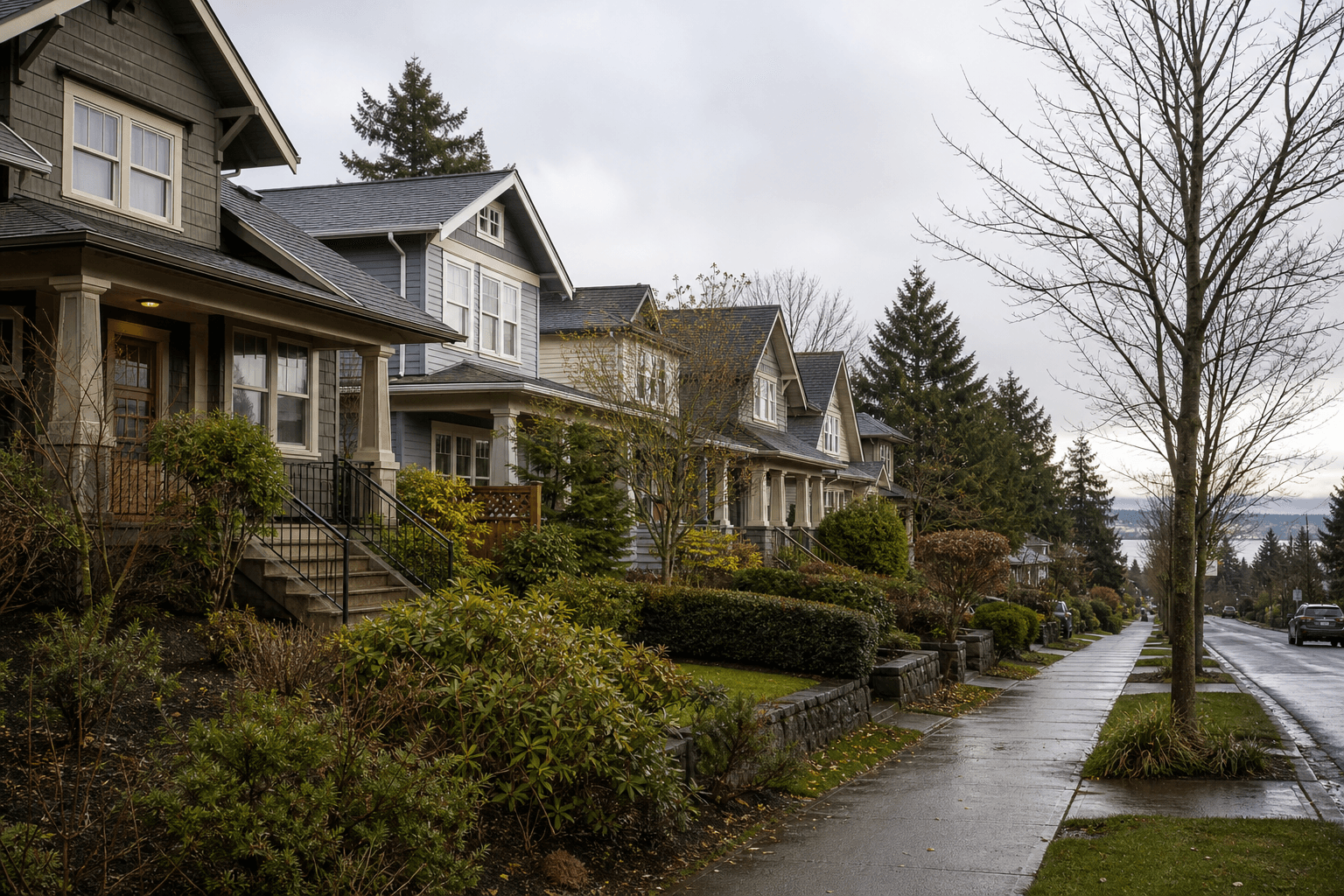
Wallingford 2026 property taxes go wrong when a preserved 1910s bungalow is valued like a renovated Fremont or Green Lake sale. The 2026 filing window is July 1 or 60 days from the Official Property Value Notice mail date, whichever is later.
If your property tax bill feels too high, the savings math below uses your own numbers. For a personalized review of your Wallingford home (a comp pull, a property record check, and a real savings estimate), enter your address on the homepage. The review is free; Fair Appeal only collects a percentage of first-year tax savings when the appeal actually wins.
Look up if you are overpaying on your Wallingford home.
King County reassesses every home every year and leans on neighborhood comps without seeing condition.
How are Wallingford property taxes calculated?
King County reassesses every Seattle property every year, including every parcel in Wallingford. The Assessor’s mass-appraisal model weights square footage, year built, lot size, and recent neighborhood sales, then applies the combined Seattle levy rate (around 0.99 percent for 2026) to the result. Voter-approved levies for schools, transit, parks, and city services layer on top of the state and county base.
What the model rarely picks up are the property-specific and Wallingford-specific factors that buyers actually price into offers, and that is where most appeals are won. Anchored by N 45th Street, Stone Way, and Gas Works Park, Wallingford’s housing stock has its own quirks the citywide model does not always capture.
Where does the Assessor get Wallingford wrong?
Wallingford's preserved housing stock is a strength culturally and a quirk for assessments. The spring valuation often groups its 1910s bungalows with renovated comps from Fremont or Green Lake that have been pushed through with permits, modern kitchens, and finished basements, none of which most Wallingford originals share.
strong evidence for a Wallingford appeal is a permit-record audit. If your home shows minimal recent permits but the model assumes a finish quality grade closer to renovated comps, that grade error is the cleanest issue to challenge with the Board of Equalization.
Wallingford comps best to itself first, and to the southern edge of Green Lake and the eastern edge of Fremont as secondary sets. A tight comp set wins these cases.
What does a Wallingford appeal actually look like?
Wallingford homeowners appeal through the King County Board of Equalization, the same independent panel that hears every Seattle and King County appeal. The 2026 filing window runs through July 1, or 60 days after your Official Property Value Notice mails, whichever is later. The hearing is short, usually 15 to 30 minutes by phone, and the Board wants concrete evidence: comparable sales, documented condition issues, or an outright error in the property record.
For the broader Seattle context, see the Seattle property taxes guide or the 2026 King County property tax appeal guide.
Is a Wallingford appeal worth filing?
At Seattle’s 0.99 percent effective rate, every $10,000 of assessed-value reduction is roughly $100 off the annual bill. A 10 percent reduction on a typical Wallingford home (recent sale prices around $1,100,000, assessed values somewhat lower) pulls roughly $1,000 a year off the bill, and reductions tied to documented evidence often land larger. Most Wallingford homes have at least one angle worth pursuing, the question is which one.
FairAppeal handles the full process from review through hearing, and only charges a percentage of first-year tax savings if the appeal actually reduces your taxes. the 2026 window is still open.
Look up if you are overpaying on your Wallingford home.
King County reassesses every home every year and leans on neighborhood comps without seeing condition.